

For most homes, the best setup is a plug-in combustible-gas alarm for continuous monitoring plus a handheld sniffer for checking fittings. Choose a handheld model to investigate stoves, water heaters, and fireplace connections; choose a plug-in alarm when you want day-and-night coverage near a natural-gas appliance.
This post contains affiliate links. As an Amazon Associate, LuxeHomeVibe earns from qualifying purchases at no extra cost to you.
If you suspect a leak now: leave the home. Do not touch switches, appliances or flames inside; call your gas utility or 911 from outside. A detector never replaces emergency services or a licensed gas professional.
- Quick picks
- Handheld sniffers vs plug-in alarms
- Best handheld sniffers for checking fittings
- Best plug-in natural gas alarms
- How to check a gas line for leaks: soap test + detector method
- LP and propane detectors for homes with propane service
- Where to install a detector
- How to choose the right detector
- Common mistakes to avoid
- FAQs
- Conclusion

Quick picks
- Best all-round handheld: TopTes PT199. Measures methane from 50–1,000 ppm and was shown with “6K+ bought in past month” on Amazon.
- Best plug-in pick: Kidde Nighthawk KN-COEG-3. Combines explosive-gas and carbon-monoxide monitoring; seen under $60 (check current price on Amazon).
- Best for awkward fittings: TopTes PT520B+. Rechargeable, with a 17-inch gooseneck probe for valves and appliance backs.
Browse the general gas leak detector options for home use, then narrow by fuel and monitoring style.
Handheld sniffers vs plug-in alarms
A handheld sniffer is used deliberately: switch it on, allow any required preparation, then move the sensor slowly around a pipe joint, valve, or connector. It helps narrow down where gas may be escaping. A plug-in alarm stays in one place and watches continuously, sounding when combustible gas builds up near it.
| Feature | Handheld sniffer | Plug-in alarm |
|---|---|---|
| Main job | Locate a suspected leak around fittings | Monitor one area continuously |
| Where it works | Stove, furnace, water heater, fireplace and meter connections | Fixed position near a gas appliance |
| Readout | Often ppm, %LEL or both, depending on model | Alarm-based monitoring; some models include a display |
| Power | Batteries or rechargeable | Household outlet, depending on model |
| Best for | Occasional checks and troubleshooting | Ongoing kitchen, laundry or utility-room coverage |
| Limitation | Only detects while you are using it | Only samples air near its installed position |
Many households use both: the plug-in provides background coverage, while the handheld shows a professional where a reading changes. Neither makes it safe to keep using an appliance you believe is leaking.
Learn how to tell if you have a gas leak before buying; recognising the signs matters more than extra features.
Best handheld sniffers for checking fittings
TopTes PT199: the straightforward starting point
The PT199’s stated methane range is 50–1,000 ppm. Ppm means parts per million, a way to describe a relatively small concentration of gas in air. That is useful when comparing one fitting with another rather than simply asking whether gas is present.
The Amazon signal “6K+ bought in past month” does not prove accuracy; popularity is not a test result. It does show a mainstream tool style for stove, fireplace and utility-room checks. Follow the start-up and calibration instructions and move slowly—rushing can miss where the reading rises.
TopTes PT205: choose %LEL if you prefer a hazard-scale readout
The PT205 is notable for its %LEL readout: percentage of the lower explosive limit, the concentration at which a gas-and-air mixture can ignite. A %LEL display expresses the reading as a proportion of that flammability threshold rather than as a raw ppm figure.
Neither scale is automatically better. ppm can be intuitive for comparing small changes around fittings; %LEL frames the result against flammability. Choose a display you understand, follow the manufacturer’s action guidance, and never decide a home is safe solely because a number looks low.
TopTes PT520B+: best where access is tight
The PT520B+ is rechargeable and has a 17-inch gooseneck probe. That flexible neck lets the sensor reach behind a range, beside a water-heater valve, or into the crowded side of a fireplace connection while you keep the display visible. It is particularly practical in finished kitchens and laundry rooms where appliances sit close to walls.
A longer probe does not make the search foolproof. Keep the sensor close to each joint, pause, then move on. If readings rise or you smell gas, stop and follow the emergency guidance above.
Klein Tools ET120 and UEi CD100A: pro-leaning alternatives
The Klein Tools ET120 and UEi CD100A recur in professional-oriented coverage and are sensible comparison points if you prefer established test-tool brands. Because this guide is research-based rather than a hands-on test report, it does not declare a winner between them. Compare sensor type, readout, probe style, calibration requirements, and support before choosing.
Best plug-in natural gas alarms
A plug-in alarm suits ongoing protection around a gas range, boiler, water heater or indoor fireplace. This is the key section for “gas detector for natural gas”: most searchers need a residential alarm in the right position, not a professional inspection instrument.
The Kidde Nighthawk KN-COEG-3 leads here because it combines explosive-gas monitoring with carbon-monoxide monitoring in one plug-in unit. The two hazards are different. Natural gas is a fuel that can accumulate and ignite; carbon monoxide is a toxic combustion by-product. A combination unit can monitor both only when designed and rated to do so.
The KN-COEG-3 was seen under $60 (check current price on Amazon). Compare current plug-in natural gas detector alarm options, because models change and the correct choice depends on outlet position, display preference, and whether you also need CO coverage.
A plug-in alarm samples air where it is installed. One hallway unit should not be assumed to protect a closed laundry room across the home. Fuel type also affects detector height, as covered below. Install each alarm where its manual specifies—not simply where the nearest convenient outlet happens to be.
How to check a gas line for leaks: soap test + detector method
If you can smell gas, hear hissing, feel unwell, or believe a leak is active, do not perform a home check. Leave and call the utility or 911. The method below is only for a calm, routine check of an accessible fitting when there are no warning signs.
1. Begin with a handheld detector sweep
Turn the detector on in clean air and allow any warm-up or self-check required by the manual. Move slowly around one joint at a time: valve stems, threaded connections, flexible-line fittings, and appliance inlets.
A rising reading or changing tone suggests you are closer to the source, but it does not identify the repair. Move away and contact a licensed professional. For this task, compare current natural gas leak detector listings.
2. Apply soapy water only to an accessible fitting
Brush a small amount of dish-soap solution over the fitting. Growing bubbles can indicate escaping gas. Keep the solution on the fitting itself and away from electrical parts or appliance controls. If bubbles form, do not tighten, dismantle, or repeatedly test the connection. Leave the repair to a licensed professional.
Never use a lighter, match, or candle to search for a leak.
3. Treat the professional recheck as the result
After repair, the professional should verify the connection. Later routine sweeps are useful, but your reading is not certification. Report any recurring odour rather than explaining it away.
LP and propane detectors for homes with propane service
“LP leak detector” results are dominated by RV products from brands such as Safe-T-Alert and MTI Industries, including 12V hardwired alarms for recreational vehicles. Those are not the automatic answer for a house. On LuxeHomeVibe, the relevant scenario is a home with propane service: a tank supplying a range, fireplace, dryer, generator, or other appliance.
Propane behaves differently from natural gas. Natural gas is mostly methane and is lighter than air, so it tends to rise. Propane is heavier than air and tends to collect near floors, basements, and other low areas. That changes detector placement and where a handheld search should concentrate.
For a propane home, discuss locations with the fuel supplier or installer. Around appliances, check regulators, valves, and flexible connectors. Browse propane gas leak detector options separately so the sensor matches the fuel. Do not install an RV-specific 12V alarm in a house unless explicitly listed for residential use.
Where to install a detector
Follow the fuel, then follow the manual
For natural gas, detectors are generally placed high because methane rises. For propane, detectors are generally placed low because propane sinks. These are starting principles only. The manufacturer may specify distance from the ceiling, floor, appliance or ventilation source, and those instructions take priority.
Kitchen
Place continuous monitoring where it can sample the cooking area without being blocked inside cabinetry. If you are planning a calm, pale scheme like our Scandinavian kitchen decor ideas, decide detector placement during the layout stage rather than after cabinets and outlets are finished. Safety equipment looks and works better when it is planned.
Laundry room
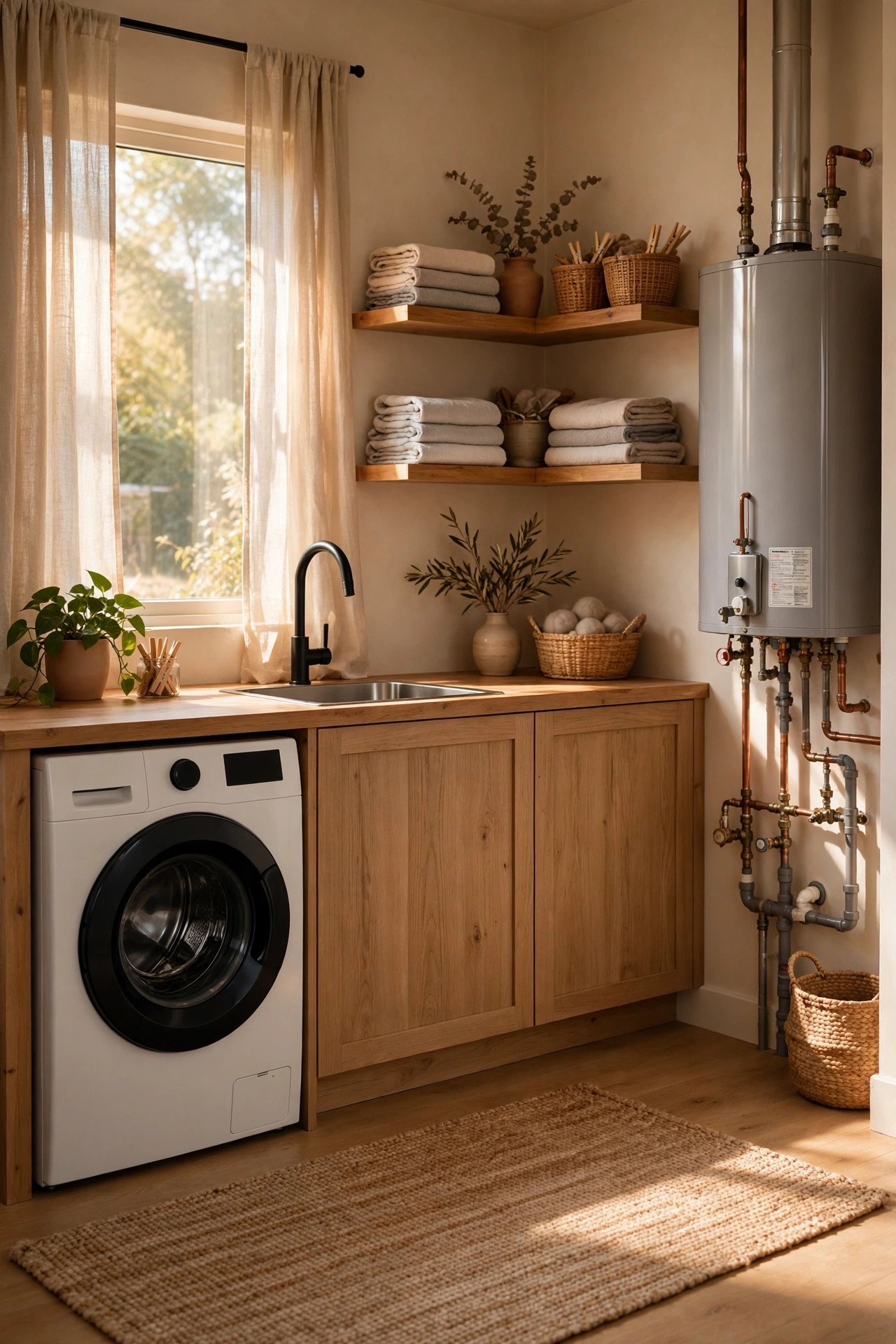
Keep the sensing path unobstructed by hampers, detergent storage or linens. Include gas dryer and water-heater connections in routine handheld checks only when there are no active warning signs.
Gas fireplace
Check the shut-off valve, flexible connector, and control area during routine maintenance. Never dismiss a gas smell around a fireplace as normal; if it persists when the fireplace is off, treat it seriously.
Basements and utility rooms
Water heaters, furnaces, and boilers concentrate several connections in one space. Low collection points matter particularly for propane. Do not paint, cover or unplug an alarm to silence inconvenience.

How to choose the right detector
Choose by task. A plug-in alarm answers, “Will something watch this room continuously?” A handheld sniffer answers, “Can I narrow down which fitting needs professional attention?” Many multi-appliance homes justify both.
Match the gas and hazard. Confirm the product is intended for natural gas, propane, or both. Carbon monoxide is a separate hazard created by incomplete combustion. A combustible-gas sensor should not be assumed to detect CO unless the product explicitly says so.
Understand the display. ppm describes concentration in parts per million; %LEL expresses it as a percentage of the lower explosive limit. Choose the display you can interpret calmly, then follow the manual rather than informal internet thresholds.
Plan calibration and replacement. Sensors can drift. Some devices self-check; others require calibration or periodic functional checks, and sensors do not last forever. Follow the specified schedule. After any alarm or unexplained reading, follow the manual and seek professional advice.
Prioritise access. A gooseneck probe helps behind appliances, a clear display matters in a dim utility room and audible changes can help during a sweep. Practical handling matters more in real use than a long feature list.
Common mistakes to avoid
- Installing a detector at the wrong height for the fuel.
- Buying an RV-specific LP alarm for a house.
- Assuming a combustible-gas detector also detects carbon monoxide.
- Typing an old price into a buying decision instead of checking the live listing.
- Using an open flame to search for a leak.
- Ignoring a faint smell because a detector has not alarmed.
- Treating one plug-in alarm as protection for every closed room.
- Attempting to repair a gas fitting after a bubble test or detector reading.
FAQs
Is a handheld gas sniffer or a plug-in alarm better?
A plug-in alarm monitors one location continuously; a handheld sniffer helps locate which fitting needs professional attention. Homes with several gas appliances often use both.
Where should a natural-gas detector be placed?
Natural gas tends to rise, so placement is generally high and near the appliance, but the manual controls the exact location. Keep the sensing path unobstructed.
What should I do if my detector alarms?
Leave the home, avoid operating switches or appliances and call your gas utility or 911 from outside. Do not re-enter to silence the device or investigate until emergency services, the utility or a qualified professional says it is appropriate.
Conclusion
Start with one correctly placed plug-in alarm in the highest-priority gas-appliance room, then add a handheld sniffer if several fittings need routine checks. Keep the rule first: suspected leak first, shopping second. Finally, review the signs of a gas leak so everyone knows what to notice.