

A self-leveling laser level projects a straight line that finds true level by itself, so your gallery wall grid, shelf line, or cabinet run ends up perfectly straight without a spirit level, a helper, or a wall full of pencil marks. For most decorating jobs, a green cross-line or 3×360° model in the budget-to-mid range is all you need.
This post contains affiliate links. As an Amazon Associate, LuxeHomeVibe earns from qualifying purchases at no extra cost to you.
- Quick Picks
- What “Self-Leveling” Actually Means (and Why It Matters Indoors)
- Laser Level vs Laser Leveler: What’s the Difference?
- Cross-Line vs 3×360°: Which Layout Suits Decorating?
- Green Beam vs Red Beam
- The Picks, in Detail
- At a Glance
- The 57-Inch Rule: Using Your Laser Like a Decorator
- Mounting Options You’ll Actually Use
- A Reality Check on Pro Brands (Milwaukee Included)
- Home Depot vs Amazon: Where Laser Levels Are Cheaper
- How We Chose (No Fake Testing)
- Frequently Asked Questions
- Conclusion
Quick Picks
- Best all-rounder for whole-room projects: CIGMAN CM-701 3×360° three full planes of light wrap the room, so one setup levels a gallery wall, a shelf line, and wainscoting height at once.
- Best on a budget: RockSeed cross-line with tripod; the tripod saves you the extra purchase most cross-line kits leave out.
- Best from a big-name brand: Bosch GLL50-20 50 ft range and IP55 dust/water resistance; we compare it against its little brother in our Bosch GLL 30 vs GLL50-20 breakdown.
What “Self-Leveling” Actually Means (and Why It Matters Indoors)
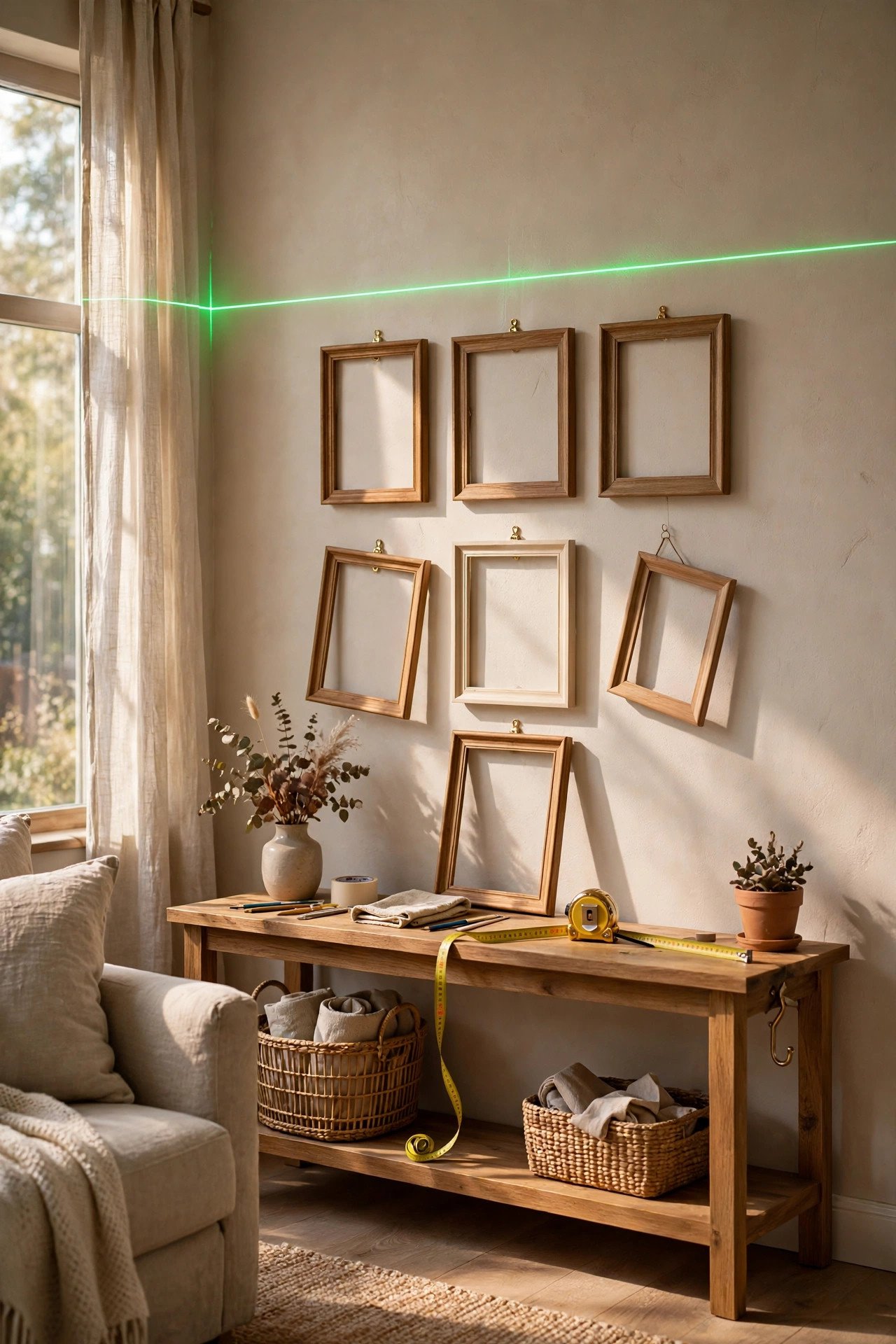
Inside the tool sits a pendulum-mounted laser. Set the unit on a surface that’s roughly level most models self-correct within a ±4° self-levelling range, and gravity does the rest: the beam settles dead level (or dead plumb, for the vertical line) while you keep both hands free for the frame, the shelf bracket or the drill.
Step outside that ±4° window and the beam blinks to warn you it’s no longer accurate. That’s a feature, not a fault. Many models also offer a lock mode: the pendulum is pinned, the blinking stops, and you can tilt the unit to project deliberately angled lines handy for stair-railing shadow lines or diagonal gallery arrangements.
For decorating, this matters more than raw power. A living room is not a building site. You need a line you can trust across a 10–16 ft wall, visible in lamplight, from a tool that fits in a kitchen drawer between projects.
Laser Level vs Laser Leveler: What’s the Difference?
If you’ve searched “laser and leveler” and landed on farm machinery, you’re not alone — that phrase is overloaded. Here’s the plain version:
- Laser level is the everyday term (and the tool name most brands use) for a device that projects a level or plumb line with a laser diode. This is what you buy for hanging pictures, shelving and cabinets.
- Laser leveler sometimes means the same consumer tool DeWalt shoppers search it constantly, which is why our DeWalt guide uses both terms. But in trade and agriculture catalogues, “laser land leveller” is a tractor-pulled grading machine that flattens fields. If a listing shows a plough, you’ve wandered into the wrong department.
- Spirit level is the bubble tool in your drawer. Still fine for a single frame; painfully slow for a nine-frame gallery grid.
Short answer: for decorating, you want a self-leveling laser level. The rest of this guide uses “laser level” throughout.
Cross-Line vs 3×360°: Which Layout Suits Decorating?
Cross-line models project one horizontal and one vertical beam that intersect in a cross. That’s the classic picture-hanging tool: the horizontal line carries a row of frames, the vertical line aligns their edges. If 90% of your projects are “lines on one wall,” a cross-line is lighter, cheaper, and simpler.
3×360° models (like the CIGMAN CM-701 and Huepar 360-style units) project full circles of light floor-to-ceiling vertical planes and a wraparound horizontal plane. One placement in the middle of the room can mark:
- a continuous shelf line across two adjoining walls
- wainscoting or picture-rail height around the whole room
- cabinet uppers at a consistent height across an L-shaped kitchen run
- the top line of a board-and-batten wall treatment
The trade-off is price and battery appetite. For a single gallery wall, a cross-line is plenty. For room-scale treatments — wainscoting, full-perimeter shelving, kitchen cabinets the 360° models earn their keep. Huepar’s 360 line is frequently mentioned alongside the CIGMAN in owner feedback as the other budget-friendly route to full-room coverage.
Green Beam vs Red Beam
Manufacturers rate green beams as up to four times more visible to the human eye than red at the same power, and in a sunlit room that difference is real: a green line stays readable across the wall where a red line washes out. That’s why most decorating-focused picks now ship green.
Red-beam models still make sense if the tool lives in a dim hallway project or your budget is firm — indoors, across typical room widths, a red cross-line does the job. But if you’re choosing one tool for bright living spaces, go green, and you won’t squint.
The Picks, in Detail
CIGMAN CM-701 3×360° the whole-room workhorse
Three 360° planes from one box: that’s the appeal. Park it near the centre of the room and a single setup throws a level line around all four walls the fastest way to carry a wainscoting height, a shelf run, or a gallery-wall top line around corners without re-measuring. In owner feedback, this class of tool is praised less for exotic specs than for removing the “move, re-level, re-check” loop from multi-wall projects.
RockSeed Cross-Line with Tripod: the budget starter
RockSeed’s cross-line bundles the accessory most brands sell separately: a tripod. For decorating that matters more than it sounds, because the hardest part of laser work at home is rarely the laser; it’s getting the beam at exactly frame height without a stack of books.
A cross-line on a tripod at the 57-inch centre height (more on that rule below) is the classic one-wall setup, and RockSeed gets you there at the friendly end of the budget.
Huepar 360 the alternative full-room route
Huepar’s 360° models sit in the same budget-to-mid band as the CIGMAN and are the other name that recurs in homeowner discussions of full-room lasers. If the CM-701 is out of stock or priced up when you shop, a Huepar 360 with the same 3-plane layout is the natural substitute; compare what’s in the box (tripod, magnetic bracket, case) rather than chasing spec-sheet decimals.
At a Glance
| Model | Beam layout | Best decorating job | Why it earns a spot |
|---|---|---|---|
| CIGMAN CM-701 | 3×360° planes | Wainscoting, wrap-around shelves, cabinet runs | One setup marks the whole room |
| RockSeed cross-line (with tripod) | Cross (H+V) | Gallery walls, single shelf lines | Tripod included; budget-friendly |
| Huepar 360 | 360° planes | Multi-wall projects | The other proven budget route to full-room coverage |
| Bosch GLL50-20 | Cross (H+V), 50 ft, IP55 | Bigger rooms, dusty renovations | Big-brand build; see the full Bosch comparison |
The 57-Inch Rule: Using Your Laser Like a Decorator
Museums hang artwork so the centre of the piece sits about 57 inches from the floor and it’s the fastest way to make a mixed-size gallery grid look intentional. With a laser, it’s a two-minute job:
- Measure your room first so the grid fits the wall. Our guide to measuring a room in 2 minutes covers the quick method.
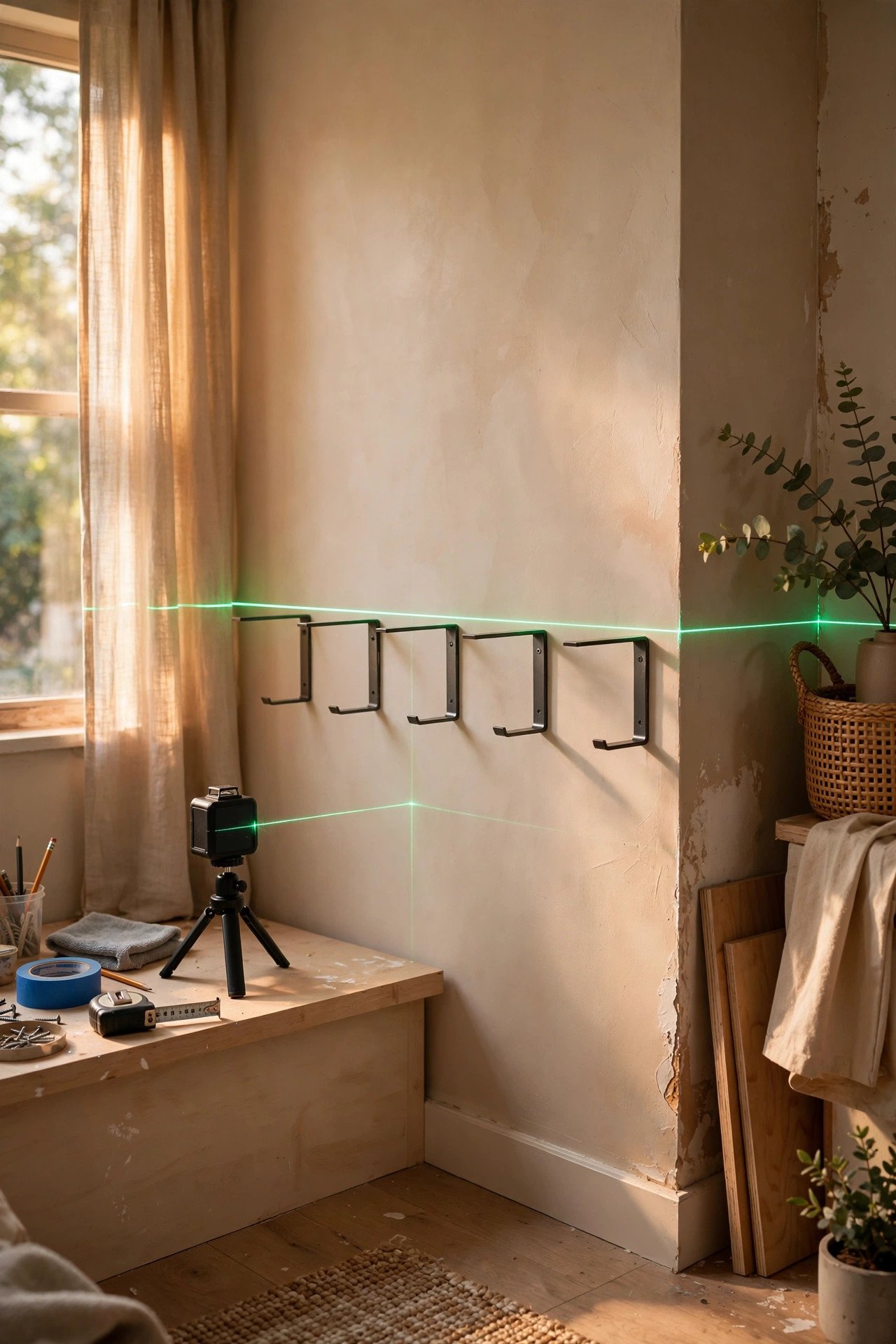
- Set the laser on its tripod so the horizontal beam sits at 57 inches.
- Hang each frame so its centre lands on the beam; use the vertical beam (or a second pass) to keep columns aligned.
For shelves, set the beam at the shelf’s underside line, mark bracket positions, then before drilling confirm you’re over studs where the load demands it. A laser draws the line; it can’t see inside the wall. Pair it with our guide to the best stud finders for home projects before heavy mirrors or loaded shelves go up.
Mounting Options You’ll Actually Use
- Tripod thread: the most stable route; a basic camera tripod works with most consumer units.
- Magnetic bracket: snaps to a metal track, fridge side or steel door frame — brilliant for cabinet work.
- Clamp/pole mounts: floor-to-ceiling poles are the pro move for cabinet runs, probably overkill for a first gallery wall.
A Reality Check on Pro Brands (Milwaukee Included)
You’ll see Milwaukee’s M12 laser line (the 3631-21 family) in roundups, and it’s genuinely excellent on a building site. It’s built around a professional battery platform, sold at jobsite prices through tool channels, and designed for daily trade abuse. For a homeowner levelling frames a few weekends a year, that money buys capacity you’ll never touch.
This is the “pro pick, usually overkill at home” category in our book: admire it, then spend the difference on frames. If you’re already on the M12 platform, see the current line-up on Amazon; otherwise, the picks above are the smarter spend.
Home Depot vs Amazon: Where Laser Levels Are Cheaper
Home Depot dominates the “buy it today” search for a reason: if a cabinet install is happening Saturday morning, a store shelf beats a delivery window, and the store stocks the same DeWalt, Bosch, and Milwaukee families.
But for decorating-scale tools, Amazon’s range of budget and mid-tier brands (CIGMAN, RockSeed, Huepar) is wider, and the big-brand consumer models frequently rotate through sale pricing there.
Our honest rule: price-check the exact model both ways on the day you buy Amazon’s current listings versus your local store shelf and factor in whether the kit includes the tripod, because that’s where the cheap headline price quietly grows.
How We Chose (No Fake Testing)
LuxeHomeVibe doesn’t run a lab, and we won’t pretend otherwise. These picks come from manufacturer specifications, published roundups, and aggregated owner feedback, cross-checked against the jobs this site actually writes about gallery walls, shelving, cabinets, wainscoting. Where a spec is manufacturer-stated, we treat it as a claim to verify in use, not a promise.
Frequently Asked Questions
How far does a decorating laser level reach indoors?
Consumer cross-lines typically cover a room comfortably — the Bosch GLL50-20 is rated to 50 ft, more than any residential wall needs. For decorating, visibility in your room’s light matters more than maximum range.
Can I see the beam in a bright, sunny room?
Green beams are meaningfully easier to see in daylight than red. If your room is glass-heavy, choose green and work with blinds half-closed for the marking step.
Do I really need a tripod?
For one frame, no. For a grid or a shelf line, yes — holding the unit or perching it on books drifts mid-job. Kits like the RockSeed that bundle a tripod remove the fuss.
Does a laser level replace a stud finder?
No. The laser draws a true line on the wall’s surface; it can’t locate the studs behind plasterboard. Heavy shelves and mirrors need both tools.
Red or green if I only buy one?
Green, if the budget allows: brighter indoors, easier on the eyes across a room, and increasingly the standard in this price band.
Conclusion
For most homes, a self-leveling green cross-line or 3×360° laser turns the most stressful part of decorating getting everything straight into the easiest.
Start with the full range of self-leveling laser levels on Amazon, match it to your next project, and if a brand-specific pick appeals, read our Bosch comparison and DeWalt guide before you decide. Straight lines, fewer holes, happier walls.