
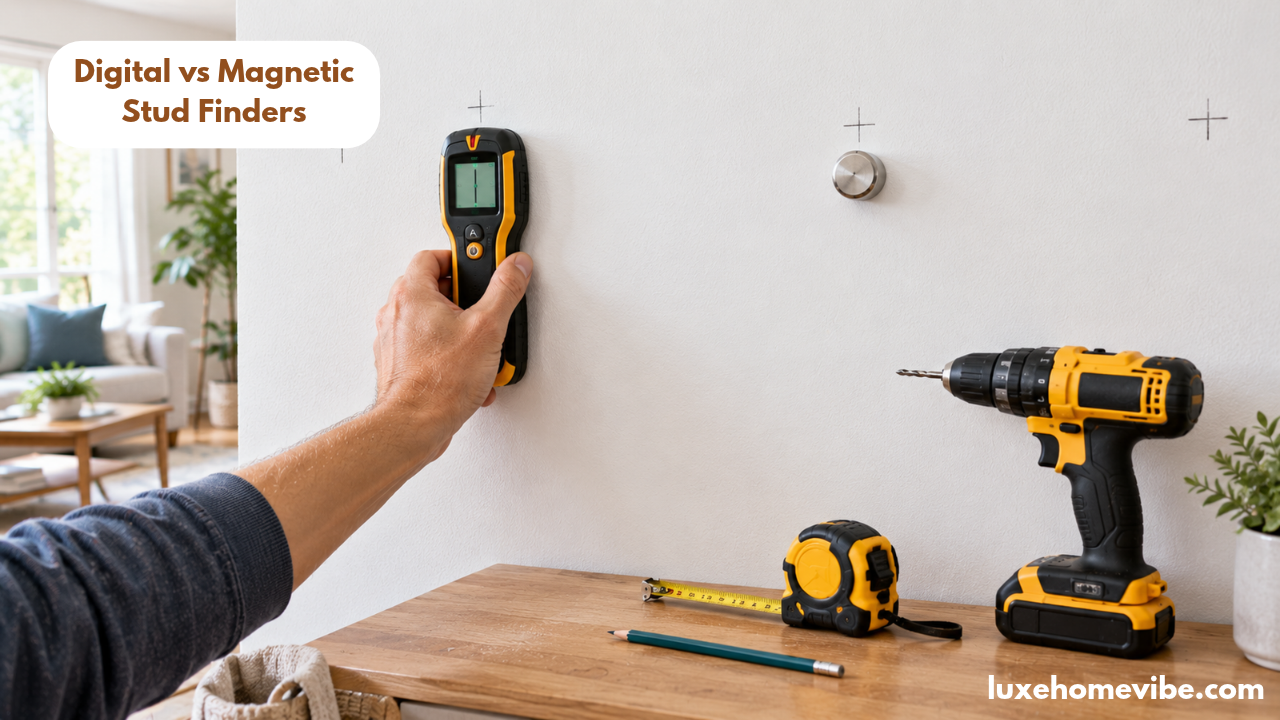
For a gallery wall, the honest answer is: the magnet finds it faster; the digital finder finds it more completely. Magnetic finders locate the screws holding your drywall and cost almost nothing; digital scanners map the stud’s edges and centre and can warn you about live wires. Your wall type and the weight on the hook decide which one wins.
This post contains affiliate links. As an Amazon Associate, LuxeHomeVibe earns from qualifying purchases at no extra cost to you.
Quick picks
- Best digital: Franklin Sensors ProSensor M210 13 sensors show the full stud width, plus live-wire detection.
- Best digital value: Franklin Sensors ProSensor M150, the same approach with nine sensors for less money.
- Best magnetic: C.H. Hanson 03040, the battery-free classic for frames and light hanging.
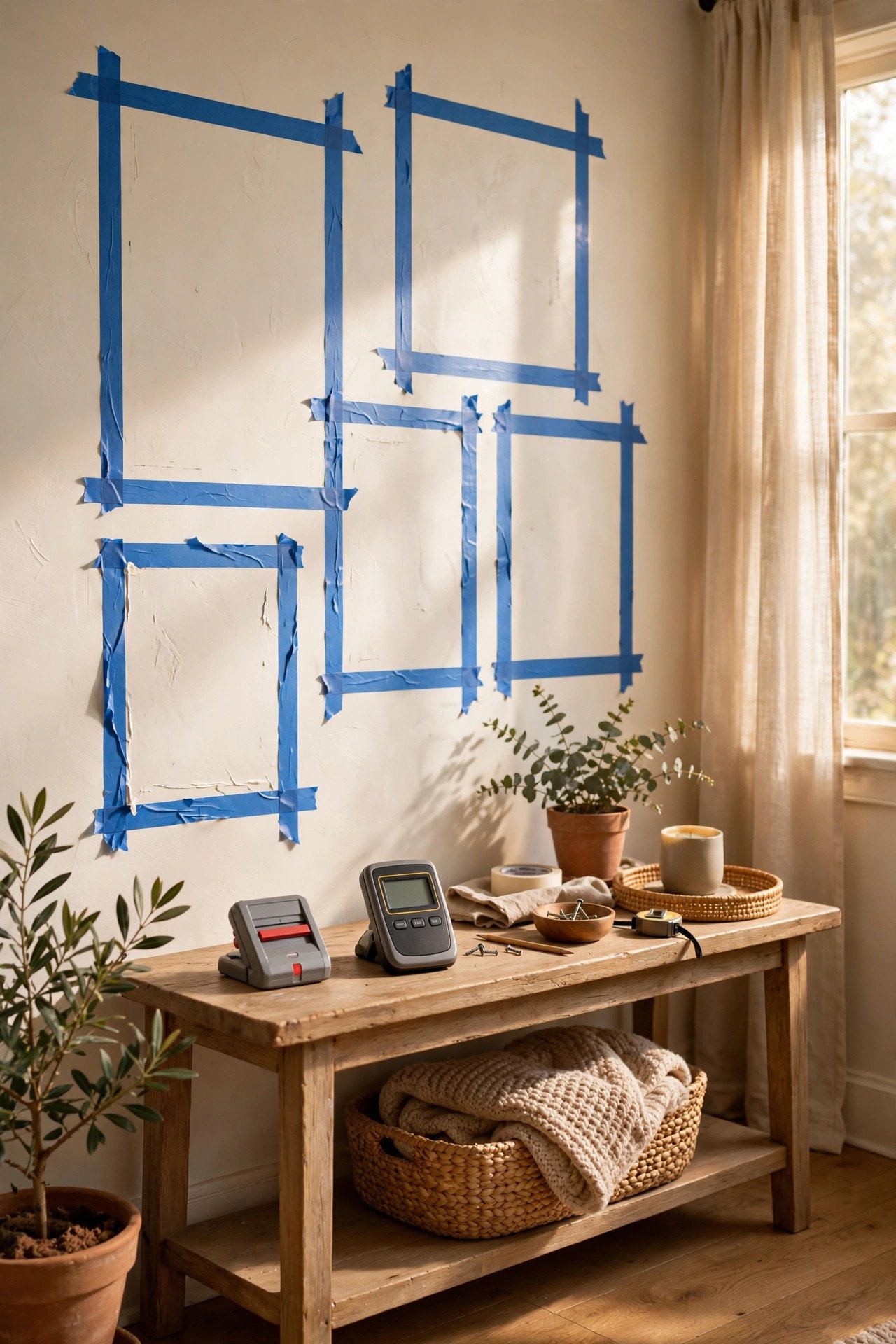
The two-minute version of how each one works
A magnetic stud finder is not really finding the stud. It finds the steel screws or nails that attach the drywall to the stud, so what you actually map is the fastener line. Two tugs of the magnet in a vertical row tell you where the stud runs, and for a framed print that is all the information you need.
A digital stud finder (the electronic scanner most people mean by “stud detector”) reads changes in density behind the wall surface and estimates where the stud begins and ends.
Better models stretch many sensors across a wide plate, light up to show the whole stud at once, and add live-wire detection so you get a warning before drilling near a cable. Check current prices on Amazon to see how wide the price spread is it runs from budget edge-finders to wide multi-sensor scanners.
That single difference fastener-finder versus stud-scanner explains everything else in this comparison, including the mistakes each type invites.
Head to head
| Digital (electronic) | Magnetic | |
|---|---|---|
| What it finds | The stud itself: edges and centre | Screws/nails fixing the drywall |
| Centre accuracy | Shown directly on multi-sensor models | Must be confirmed (nail test) |
| Live-wire warning | On many models | Never |
| Batteries | Yes | None, ever |
| Wall quirks | Can struggle on lath-and-plaster, thick or textured walls | Needs metal fasteners; odd on metal studs |
| Speed for one picture | Slower (calibrate, scan) | Faster (glide, tug, mark) |
| Typical cost | ~$24 budget to ~$60 multi-sensor (check current price on Amazon) | Low; small hand tool pricing |
| Best at | TVs, shelves, heavy mirrors | Frames, gallery walls, light decor |
Prices above are guides from the researched shortlist. Zircon’s StudSensor A100 anchors the digital budget end around $24, Franklin’s M210 sits around $59.99, and the M150 lands roughly in the $45–55 band (check current price on Amazon in every case, because tool pricing moves). Our full researched roundup of both families lives in the best stud finders for home projects.
Where digital clearly wins
Anything heavy or expensive. A television, a loaded floating shelf, an oversized mirror: these need the centre of the stud, confirmed, with a wire warning on duty. Digital is not the premium choice here; it is the only responsible one. The TV case gets its own walkthrough in how to find studs for a TV mount.
Thick, tiled, or doubled walls. Where magnets weaken with every extra layer between magnet and screw, a digital scanner with a deeper scan mode still has a working method slower and fussier, but functional.
Your confidence. Multi-sensor displays that paint the stud’s width remove the interpretive step that makes beginners nervous. If the tool’s job is to make you willing to drill, that clarity is a feature, not a luxury.
Where magnetic quietly wins
The gallery wall itself. Eleven frames, most of them light, all of them needing “close enough to a stud or a good hook.” A magnet glides, tugs, and marks in seconds per piece, with no calibration ritual between frames. The full technique, including the vertical-line test that separates real studs from random metal, is in the magnet trick that finds every stud.
Lath-and-plaster walls. Old walls confuse density scanners with their uneven build-up, while the screws or nails fixing the lath still pull a magnet. Expect a messier pattern than drywall, but a usable one.
The drawer test. Magnets need no batteries, never expire, and survive being lent to neighbours. Owners consistently report the magnetic finder is the one that actually gets used for small jobs, precisely because using it takes ten seconds.

The gallery wall verdict, scenario by scenario
- All light frames, standard drywall: Magnetic. Mark the stud lines you find, put hooks where the art wants them, and anchor the largest piece into a stud.
- One oversized statement piece over a console: Digital for that piece centre-confirmed, cleat-friendly magnetic for the satellites around it.
- Mixed wall of shelves plus frames: Digital first to map every stud across the run, then plan shelf brackets on the structure and frames in the gaps. A laser line helps the arrangement; the finders feed it honest anchor points.
- Plaster walls in an older home: Start magnetic, verify with the nail test in a hidden spot, and keep toggle bolts rated for the load as the honourable plan B between studs.
- Renting, minimal holes: Magnetic plus quality picture hooks for everything light; the one stud-anchored hero piece is worth its two small, fillable holes.
The mistakes each type invites
Digital owners drill on the first beep without marking both edges, scan too fast, and forget that calibration on an already-studded spot poisons every reading after it. Magnetic owners assume the screw they found is the stud’s centre (it is a line, not a centre), forget there is no wire warning standing guard, and chase false tugs from corner bead and duct straps.
Both camps share one sin: hanging something heavy on a single unverified mark. Two methods agreeing, or one method plus the nail test, is the standard anything valuable deserves.

FAQs
Which is more accurate, digital or magnetic?
Digital, for position: multi-sensor models show edges and centre directly. Magnetic finders are accurate about fastener location but only imply the stud’s line, so centre must be confirmed separately.
Can a digital stud finder replace a magnet entirely?
For heavy and mixed projects, mostly yes. But owners who keep both tend to grab the magnet for quick frames — no batteries, no setup — and the scanner for loads. They are complements more than rivals.
Why does my digital finder struggle on plaster?
Lath-and-plaster density varies a lot, which confuses density-based scanning. Magnetic finders often do better there because lath fasteners still respond; test in a hidden area either way.
Is live-wire detection worth paying for?
If you drill anywhere near outlets, switches or sconce wiring which is to say, most decorated walls yes. It is the one digital feature with no magnetic equivalent at any price.
What should a first-time buyer get for a gallery wall?
A magnetic finder if every piece is light; a mid-range digital model such as the M150 if the wall includes a heavy mirror, shelf or TV. See it on Amazon to compare the current options.
Conclusion
Digital finds the stud; magnetic finds the screws that betray it. Choose digital when weight, wires, or wall thickness raise the stakes; magnetic when speed and simplicity serve a wall of lighter things, and do not be surprised if the right long-term answer is one of each. Start with the family your next project demands: check the current price on Amazon, then hang the gallery wall as you meant it.